How to Safely Buy and Sell Black Desert Online Accounts in the MMO Marketplace
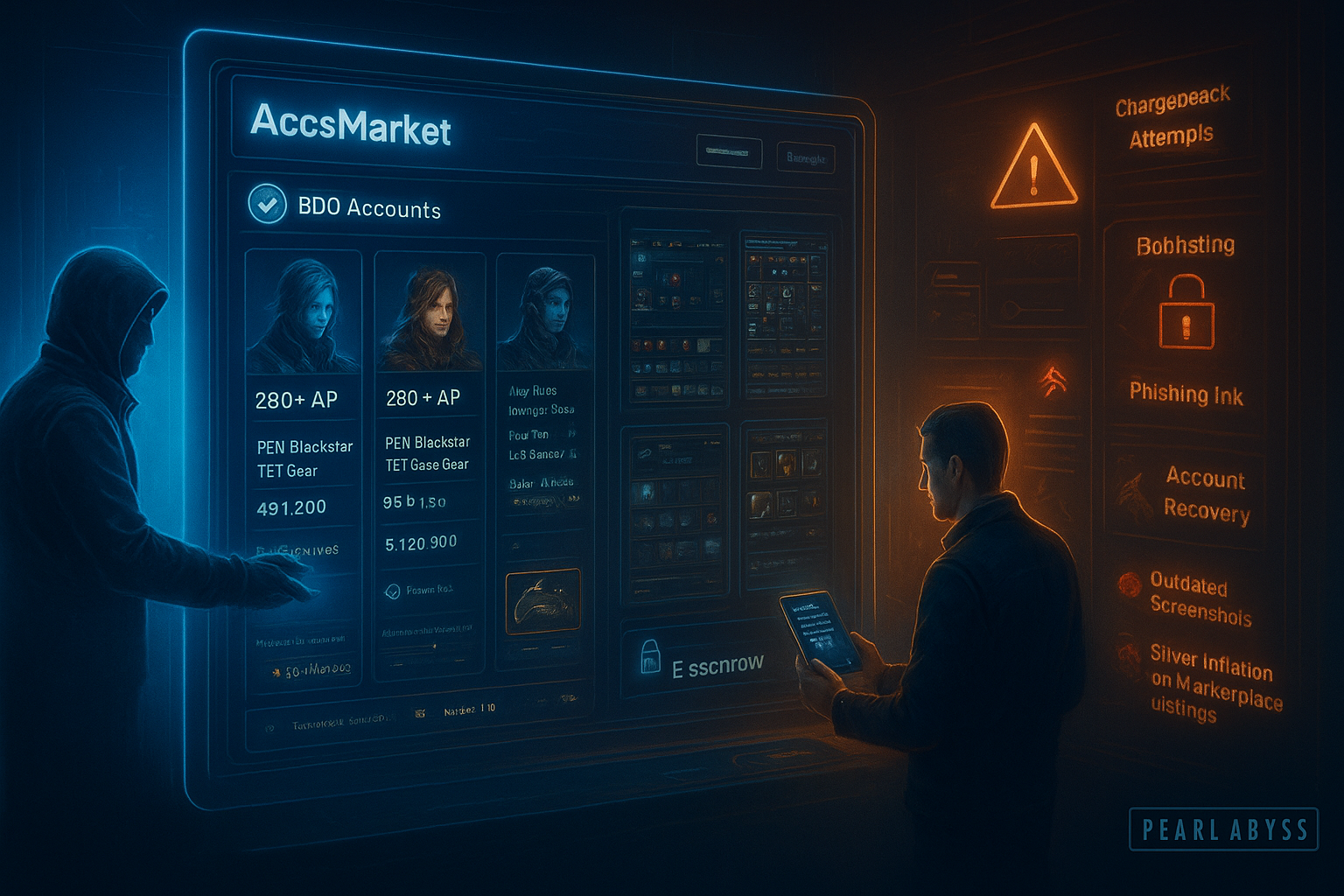
Black Desert Online has one of the steepest gear progression curves in the MMORPG genre. A single enhancement attempt at the highest tiers can consume months of grinding, and the gap between a mid-tier and endgame account represents not just effort but a significant real-world time investment. That reality has given rise to a thriving secondary market where players exchange accounts, and the volume of transactions happening across various platforms makes this a genuinely mature ecosystem - not a niche gray market.
Players sell BDO accounts for entirely rational reasons: they quit the game, switch regions, burn out after a failed enhancement session, or simply want to convert years of effort into cash. On the buying side, returning veterans, players migrating from other MMORPGs, and people who want to experience endgame content without a multi-year commitment all represent real, consistent demand. If you're looking to buy BDO accounts, platforms like buy bdo accounts on AccsMarket provide a structured environment with verified listings, making the process far more accessible than hunting through forums or Discord servers.
What this market lacks by default is safety. Without the right knowledge, buyers risk purchasing banned or misrepresented accounts, and sellers risk non-payment, chargebacks, or having their transactions reversed entirely. This article covers both sides of the transaction - how accounts are valued, where to trade, how platforms protect you, what risks exist, and how to complete a deal without exposing yourself to fraud.
Understanding the BDO Account Marketplace
The BDO account marketplace operates on a straightforward supply-and-demand principle, but the product being traded is far more complex than a simple digital item. A Black Desert Online account is not just a character - it encompasses an entire family system that spans multiple characters, gear sets, silver balances, Pearl Shop currency, life skill progress, pets, mounts, inventory expansions, and family-wide achievements. When someone purchases an account, they are acquiring everything attached to that family profile, which is why account valuations in BDO tend to be higher and more nuanced than in many other MMORPGs.
The secondary market exists because Pearl Abyss has intentionally designed a progression system that rewards sustained engagement. Enhancement is RNG-based, gear degrades on failure at certain tiers, and the grind required to reach the highest AP brackets takes dedicated players well over a year of consistent play. That design creates genuine monetary value in high-tier accounts, because the time cost of replicating one from scratch is substantial. The MMORPG account sales market around BDO reflects that value directly.
Sellers in this market fall into several recognizable categories:
- Players leaving the game permanently who want to recover some return on their time investment
- Players switching to a different region or server where their current account cannot follow
- Players who want to fund a fresh start on a new class without losing their progress entirely
- Players experiencing financial pressure who see their account as a convertible asset
- Players who reached their content goals and have no further motivation to continue
Understanding what constitutes a complete BDO account is essential before evaluating any listing. The core components that carry value include:
- Main character gear score expressed as AP (Attack Power) and DP (Defense Power)
- Enhancement tiers on weapons and armor, particularly boss gear and Blackstar items
- Silver balance and Marketplace deposit listings
- Pearl balance remaining in the account
- Number and quality of characters, including awakened and succession builds
- Life skill grades across cooking, alchemy, fishing, trading, and processing
- Pets, their tiers, and their combined looting speed
- Mount quality, including tier 9 and tier 10 horses
- Loyalty points, inventory slots, and weight limit expansions
Why the Secondary Market for BDO Accounts Exists
The secondary market for BDO accounts is a direct consequence of how the game distributes its rewards. Unlike MMORPGs where gear is time-gated through weekly raid resets, BDO's enhancement system creates enormous variance. Two players who invest identical hours can end up with dramatically different accounts depending on enhancement luck. This randomness means some accounts far exceed what grinding time alone would predict - and those accounts carry real worth to someone who wants that level of power without the variance risk.
From the buyer's perspective, purchasing an account is an economic decision. If a player values their non-gaming time at any reasonable rate, the cost of buying a 280+ AP account is often lower than the equivalent time investment required to build one. That calculation drives consistent demand. The same logic applies in reverse to sellers - an account that represents two years of play sessions has genuine value that evaporates the moment the account goes dormant, giving sellers motivation to convert it while it remains relevant.
Black Desert Online trading at the account level also exists because the game's content is gated behind gear thresholds in a very direct way. Players who cannot reach certain AP benchmarks are effectively locked out of the most rewarding grinding spots. That creates a market where endgame access has a clear dollar equivalent, and buyers are willing to pay for it.
What Makes BDO Account Trading Unique Among MMORPGs
BDO's family-based account system is its most distinctive feature in the context of account trading. Every character, piece of shared inventory, and account-wide currency belongs to the family rather than to a specific character. This means buying one account gives the buyer access to all characters simultaneously - a level of comprehensive value that is less common in games with per-character progression systems.
The enhancement system also creates a valuation complexity that traders in other MMORPGs do not encounter to the same degree. A single PEN (Pen level V) enhancement on a Blackstar weapon represents an enormous investment of resources and probability, and its value on the secondary market reflects that scarcity. Buyers need to understand enhancement tiers to evaluate listings accurately, and sellers need to communicate those tiers clearly to justify their asking price.
One important caveat for buyers: Pearl Shop cosmetic items, region-specific content, and some Pearl-purchased functional items may not transfer in the way buyers expect. Pearl balance transfers with the account, but items already consumed or applied to characters are not recoverable. Region locking is also a real constraint - an account registered on the North American server cannot be used on the European or Korean versions of the game without a fresh start.
Evaluating BDO Game Accounts for Sale: What to Look For
Walking into the BDO account marketplace without knowing how to evaluate a listing is one of the fastest ways to overpay or get defrauded. The information asymmetry between a seller who knows their account inside out and a buyer who only sees a listing description creates real risk. Closing that gap requires a systematic approach to verification before any money changes hands.
The most important starting point is understanding what you are actually paying for. A listing that reads "285 AP Warrior, full boss gear" tells you very little without knowing enhancement levels, pet quality, silver balance, and whether those numbers reflect the main character alone or a family average. Sellers sometimes present their account's best-performing character while omitting that the rest of the family is underdeveloped.
Use the following checklist when reviewing any BDO game accounts for sale:
- Request current screenshots of the character equipment window showing all gear pieces and their enhancement levels
- Ask for a screenshot of the family inventory and storage showing silver balance and item stock
- Confirm Pearl balance remaining in the account
- Request the pet window showing pet tiers and combined loot collection speed
- Verify life skill grades through a screenshot of the life skill tab
- Check mount quality, especially if the listing mentions high-tier horses
- Ask about the account's ban history and whether it has ever been flagged for third-party software
- Confirm the server region and verify that it matches your intended play region
Red flags that should cause you to pause or walk away entirely include:
- Listings with no screenshots or only promotional artwork instead of actual account views
- Prices dramatically below comparable listings without a clear explanation
- Sellers who cannot answer specific questions about the account's details
- No verified transaction history on the platform the seller is using
- Requests to move the conversation off the platform before completing the sale
- Pressure to complete the transaction quickly without time for verification
Key Metrics That Determine Account Value
AP and DP are the primary gear metrics in BDO, and they form the baseline of any account valuation. AP determines how much damage a character deals and directly gates access to the most profitable grinding zones. DP affects survivability, particularly in PvP content. However, raw AP and DP numbers alone do not tell the full story - the source of those numbers matters significantly.
Enhancement tiers on weapons and armor are the real driver of value. The enhancement system in BDO progresses through DUO, TRI, TET, and PEN stages, with each stage representing a logarithmically increasing investment of resources and probability. A weapon enhanced to PEN is not just incrementally better than TET - it represents an order of magnitude more grinding and materials to produce. The table below summarizes how enhancement tiers map to market significance:
| Enhancement Tier | Market Significance | Notes |
|---|---|---|
| TRI (III) | Entry-level endgame baseline | Common in mid-tier accounts; minimal premium over lower enhancements |
| TET (IV) | Significant value increase | Represents substantial resource investment; notably harder to achieve than TRI |
| PEN (V) - Standard gear | High-value tier | Rare on standard boss gear; meaningfully increases account asking price |
| PEN (V) - Blackstar or Fallen God | Premium tier | Represents the highest enhancement achievements; commands the largest price premium |
Life skill grades deserve more attention than many buyers give them. A family with Master or Guru-level life skills in cooking, alchemy, or processing has a passive income engine built in. That functionality adds real value that may not be immediately visible in a gear-focused listing. Similarly, a large stable of high-tier pets with useful skills can generate measurably more silver per hour than a comparably geared account with weak pets.
Spotting Fraudulent or Overvalued Listings
Misrepresentation in BDO account listings takes several consistent forms. The most common involves silver balance inflation - a seller lists items on the in-game Marketplace at high prices and counts those listings as part of the account's silver balance, when in reality those items may never sell or may sell at a much lower price. Always ask for a screenshot showing actual silver on hand rather than silver tied up in active listings.
Outdated screenshots are another frequent issue. A seller may use screenshots taken during a period when their account was at peak gear, while the account has since been degraded through failed enhancement attempts. Request screenshots taken within 24 hours of the listing going live and check the timestamp if the platform allows it.
Additional misrepresentation tactics to watch for include:
- Presenting combined family AP/DP as if it represents a single character's stats
- Omitting the absence of pets or listing low-tier pets without disclosing their grade
- Failing to mention that high-value items are in worker lodging or on loan to a node
- Not disclosing a previous ban, automated play detection, or ongoing restriction
If a seller is legitimate, they will have no objection to providing a live screen share or a video walkthrough of the account before the transaction. Resistance to that request is itself a meaningful signal.
How to Safely Sell BDO Accounts
Selling a BDO account safely requires preparation before the listing goes live, not just during the transaction. Sellers who rush to list without documenting their account properly tend to attract lowball offers, skeptical buyers, and drawn-out negotiations that drag down the final sale price. A well-prepared seller controls the transaction from the start.
The process of taking an account from ready-to-sell to completed transaction follows a clear sequence:
- Document every relevant aspect of the account with current screenshots - gear, silver, pearls, pets, mounts, life skills, and family achievements
- Research current market prices by reviewing active and recently completed listings for comparable accounts
- Choose a reputable platform with escrow payment and a seller dispute mechanism
- Create a detailed, accurate listing that includes all documented information without exaggeration
- Respond to buyer inquiries promptly and honestly, providing additional screenshots on request
- Agree on a price and initiate the transaction through the platform's official payment system only
- Deliver account credentials only after payment is secured in escrow
- Complete the post-sale handover process to fully separate yourself from the account
A general pricing reference for BDO accounts depends heavily on gear tier, region, and current demand. The following table provides a broad orientation rather than precise figures, as market prices fluctuate with game updates and player population:
| Account Tier | Approximate Gear Range | General Price Bracket | Notes |
|---|---|---|---|
| Entry-level | 200-240 AP, TRI gear | Low range | Suitable for new players wanting a head start; competitive supply |
| Mid-tier | 250-270 AP, TET boss gear | Mid range | Most common listing category; pricing sensitive to pet and life skill quality |
| High-end | 280-295 AP, mixed TET/PEN | Upper range | Strong demand from returning veterans and switchers |
| Premium | 295+ AP, PEN Blackstar or Fallen God | Premium range | Small buyer pool but very motivated purchasers; documentation critical |
Pricing Your Account Correctly
Setting the right price is the single most important factor in how quickly an account sells and at what return. Overpriced accounts sit on platforms for weeks without interest, accumulating platform visibility costs and becoming stale. Underpriced accounts sell immediately but leave real value on the table. Both outcomes are avoidable with proper market research.
The most reliable way to calibrate pricing is to review currently active listings and, where the platform allows it, completed sales for accounts with similar gear scores. Pay attention to details beyond AP - accounts with large pearl balances, high-grade pet sets, or Guru-level life skills consistently command premiums that comparable gear-only accounts do not achieve.
Factors that push a price higher when you sell BDO accounts include:
- PEN or Blackstar-tier enhancements on primary weapons
- Large unrestricted pearl balance
- High-tier pets with rare or strong skills
- Tier 9 or Tier 10 horses
- Multiple characters at or near endgame gear levels
- Guru or Master life skill grades across multiple categories
- Rare family titles or achievement completions
Factors that reduce market value include limited server region, a ban history, low pearl balance, poor pet quality, and a main character on a less popular class that has a smaller buyer pool.
Protecting Yourself During the Transaction
Sellers face two primary fraud risks: non-payment and chargebacks. Non-payment is straightforward - a buyer takes the account credentials and disappears before paying. Chargebacks are more sophisticated - a buyer pays, receives account access, then disputes the transaction with their bank or payment provider, recovering their money while keeping the account. Both risks are largely eliminated by using a platform with a proper escrow system that holds payment until both parties confirm the transaction is complete.
After confirming that payment has been secured in escrow and released to your account, complete the following post-sale steps before considering the transaction closed:
- Provide the buyer with all login credentials simultaneously, including the registered email and password
- Remove any personal payment methods linked to the account before handover
- Confirm with the buyer that they have successfully logged in and can access the account
- Remove the account from any personal device autofill or saved password managers
- Keep a record of the completed transaction for your own reference
One rule that must be stated without ambiguity: attempting to recover an account after completing a sale is fraud. It does not matter whether the buyer changed something you disliked or whether you regret the price. Account recovery after a completed transaction exposes you to platform bans, permanent seller account suspension, and depending on jurisdiction, potential civil liability. The moment a transaction closes, the account belongs to the buyer entirely.
Choosing the Right Platform for BDO Account Transactions
The platform you use for Black Desert Online trading determines the baseline safety level of every transaction you complete. A well-designed platform provides escrow payment, identity verification, seller rating systems, and dispute resolution. A poorly designed one provides nothing more than a listing board, leaving all risk management to the parties involved. The difference between these two categories is not marginal - it is the difference between a manageable transaction and a potential total loss.
Three broad platform categories serve the BDO account marketplace, each with a different risk and fee profile:
| Platform Type | Buyer Protection | Seller Protection | Fee Structure | Fraud Risk |
|---|---|---|---|---|
| Dedicated MMORPG marketplaces | Escrow, disputes, verification | Rating system, escrow release | Percentage of sale, typically transparent | Low when platform is reputable |
| General trading sites | Variable; check per platform | Variable; chargeback exposure possible | Varies by platform structure | Medium; depends on platform maturity |
| Discord/forums/peer-to-peer | None by default | None by default | No fees, but no protection either | High; no recourse if fraud occurs |
When evaluating a specific platform before committing to MMORPG account sales through it, look for the following features:
- A formal escrow system that holds buyer payment until account delivery is confirmed
- Verified seller profiles with visible transaction history and ratings
- A documented dispute resolution process with clear timelines
- Transparent fee disclosure before listing or purchasing
- Active customer support with a reasonable response window
- Clear terms of service that explain what happens in cases of fraud or non-delivery
Warning signs that a platform should not be trusted include anonymous seller profiles with no history, no published buyer protection policy, requests to complete payment outside the platform itself, and an absence of any dispute mechanism. The last point is particularly important - a platform with no dispute resolution is simply a notice board, and using it carries the same risk as any unmediated peer-to-peer exchange.
Understanding Escrow and Buyer Protection Systems
Escrow is the mechanism that makes account trading workable for both parties. In a standard escrow transaction, the buyer's payment is sent to a neutral third party - the platform - rather than directly to the seller. The seller then delivers the account. Once the buyer confirms that the account is accessible and matches the listing description, the platform releases the funds to the seller. Neither party has both the money and the account at the same time until the transaction is formally completed.
The escrow process for a typical account transaction follows this sequence:
- Buyer submits payment to the platform's escrow system
- Platform confirms payment receipt and notifies the seller
- Seller provides account credentials to the buyer
- Buyer logs in, verifies account access and condition
- Buyer confirms successful receipt through the platform
- Platform releases funds to the seller's account
If the account does not match the listing description - missing gear, lower pearl balance than advertised, or no login access - the buyer opens a dispute before confirming receipt. The platform then mediates, typically requesting evidence from both sides before deciding whether to release funds or issue a refund. This mechanism is why using a platform with formal dispute resolution is non-negotiable for any transaction above minimal value.
One important practical warning: fake escrow sites exist specifically to target account traders. Fraudsters in peer-to-peer communities sometimes direct buyers to a website that mimics a legitimate escrow service but simply collects payment and disappears. Always verify that the escrow service you are using is an integrated part of the trading platform itself, not a third-party site suggested by the other party in the transaction.
Risks, Warnings, and Legal Considerations
Account trading in Black Desert Online exists in a clearly defined gray area that every participant should understand before completing a transaction. Pearl Abyss, the developer of BDO, prohibits the buying, selling, or transfer of accounts in its Terms of Service. This prohibition applies to all regional versions of the game. The consequence of detection is account termination without refund or appeal in most cases.
That said, Pearl Abyss does not actively police account transfers the way it monitors in-game RMT (real money trading of silver or items). Detection of an account sale typically occurs when new account behavior patterns are dramatically inconsistent with the account's history, when the original owner contacts support to report the transfer, or when the buyer uses tools that trigger automated detection. Understanding where the risk concentrates helps both parties make informed decisions.
The risk landscape for BDO game accounts for sale covers several distinct threat categories:
| Risk Type | Who It Affects | How to Mitigate |
|---|---|---|
| Terms of Service ban | Buyer primarily | Avoid dramatic post-purchase behavior changes; do not use third-party software |
| Account recovery by original owner | Buyer | Use platforms with identity verification; change all account credentials immediately after purchase |
| Chargeback fraud | Seller | Use escrow platforms that do not release funds until buyer confirms access |
| Phishing and credential theft | Both parties | Enable two-factor authentication; never click links from unknown parties during a transaction |
| Fake escrow or platform scams | Both parties | Only use escrow integrated into the trading platform itself; verify URLs carefully |
The most common scam formats in MMORPG account sales follow predictable patterns:
- Fake escrow sites that collect payment and provide no account or recourse
- Sellers who complete the sale and then use original contact information to recover the account through Pearl Abyss support
- Buyers who pay via a chargeback-eligible method and dispute the transaction after receiving account access
- Phishing links sent during negotiation that mimic platform login pages but steal credentials
- Sellers who use edited screenshots to misrepresent account value
ToS Implications and Account Ban Risk
Pearl Abyss's Terms of Service explicitly prohibit account transfer and the sale of accounts for real money. Accepting this when choosing to participate in the secondary market is not optional - it is a precondition for making an informed decision. Buyers should understand that they are purchasing access to an account with no official recourse if Pearl Abyss terminates it. There is no appeals process that will be sympathetic to a buyer who explains they purchased the account from someone else.
The practical ban risk, however, is not uniformly high. Accounts that are transferred quietly, without triggering unusual behavior patterns, often continue operating indefinitely. The elevated risk scenarios are specific: accounts with a prior botting history, accounts where the original owner contacts support to report the sale, and accounts where the new owner immediately engages in behavior flagged by automated systems.
Two practical steps reduce post-purchase ban exposure significantly. First, avoid making dramatic changes to the account's activity patterns immediately after purchase - large-scale gear selling, rapid silver movement, or sudden shifts in grinding location can draw automated attention. Second, before purchasing any account, directly ask the seller whether the account has ever received a warning, temporary suspension, or investigation notice. An account with a clean history is meaningfully safer to operate than one with prior flags.
Protecting Against Account Recovery Fraud
Account recovery fraud is one of the most damaging scenarios a buyer can face. It works like this: a seller completes the transaction, receives payment, and then contacts Pearl Abyss support using the original registered email address and personal information to report the account as compromised. If the support team accepts the claim and restores access to the original owner, the buyer loses both the account and their money.
This scenario is far less likely when the platform used for the transaction requires seller identity verification - because the seller's identity is on record and fraudulent recovery attempts can be traced. It is extremely common in unmediated peer-to-peer trades where the seller remains anonymous.
To secure a purchased account against recovery attempts, complete the following steps immediately after gaining access:
- Change the registered email address to one you control and have never shared
- Change the account password to a strong, unique password
- Update the registered phone number to your own number
- Enable two-factor authentication using your own authenticator application
- Remove any payment methods linked to the original owner
- Review and update any secondary recovery options in the account settings
Once you have completed these steps, the original owner's ability to recover the account through normal support channels drops substantially, because the account's contact information no longer matches what they can provide to verify identity.
Step-by-Step Guide: Completing a Safe BDO Account Transaction
Everything covered in the preceding sections converges here into two practical workflows - one for buyers and one for sellers. These are not abstract recommendations. They are the actual sequence of actions that produce safe, completed transactions in the BDO account marketplace.
For buyers, the full process looks like this:
- Identify reputable platforms that offer escrow payment and verified seller profiles
- Create an account on the platform and review its buyer protection policy before proceeding
- Search for listings that match your target gear range and budget
- Apply the evaluation checklist from Section 2 to any listing you are seriously considering
- Contact the seller and request current screenshots or a live walkthrough of the account
- Agree on a price and initiate payment through the platform's escrow system only
- Receive account credentials after escrow payment is confirmed
- Log in and verify that the account matches the listing description before confirming receipt
- Confirm the transaction through the platform to release payment to the seller
- Immediately complete all account security steps - change email, password, phone, and enable 2FA
For sellers, the complete process follows a parallel structure:
- Document the account thoroughly with current, timestamped screenshots of all key account components
- Research comparable listings to set a competitive and accurate price
- Choose a platform with seller protections and a formal escrow mechanism
- Create a detailed listing that honestly represents the account without exaggeration or omission
- Respond to buyer inquiries accurately and provide additional evidence on request
- Agree on price and direct the buyer to complete payment through the platform's official escrow
- Deliver account credentials only after escrow payment is confirmed as held
- Assist the buyer in confirming access without surrendering control prematurely
- Remove personal payment methods and sensitive information before completing handover
- Wait for the buyer to confirm receipt before considering the transaction closed
The following table shows both parties' responsibilities at each transaction stage side by side:
| Transaction Stage | Buyer Action | Seller Action | Safety Note |
|---|---|---|---|
| Pre-transaction | Evaluate listing, verify details | Document account, set accurate price | Neither party should rush this stage |
| Platform selection | Confirm escrow and buyer protection | Confirm escrow and seller protection | Both parties should use the same platform |
| Payment | Pay through platform escrow only | Do not request off-platform payment | Off-platform payment offers are a scam signal |
| Credential delivery | Wait for credentials after escrow confirmed | Deliver credentials after escrow confirmed | Seller should never deliver before escrow is funded |
| Verification | Log in and verify account condition | Remain available for access questions | Buyer should verify before confirming receipt |
| Completion | Confirm receipt to release funds | Remove personal data from account | Buyer secures credentials immediately after |
If something goes wrong - the account is not as described, login fails, or the account appears restricted - do not confirm the transaction. Open a dispute through the platform immediately, document everything you observe, and provide the platform's support team with screenshots of both the listing and the current account state. Reputable platforms have processes for exactly this scenario, and acting quickly before confirming receipt is what preserves your ability to recover payment.
Tips for Getting the Best Value Whether Buying or Selling
Safety and good value are not the same goal, though they are compatible ones. Once you understand how to complete a transaction safely, the next layer of skill is getting the best outcome from it - paying a fair price as a buyer or maximizing your return as a seller. Both sides of the BDO account marketplace have genuine optimization levers available.
For buyers looking to stretch their budget further:
- Check listings shortly after a major game update or balance patch - players who feel their class was weakened sometimes sell quickly at below-market prices
- Look for accounts whose listed gear score is slightly below the premium tier but whose life skill level, pet quality, or pearl balance adds unpriced value
- Target sellers with urgency signals in their listing - phrases like "quick sale" or accounts listed well below comparable listings often indicate a motivated seller
- Consider accounts with strong support characters even if the main character is mid-tier - a family with multiple developed characters has hidden utility
For sellers aiming to increase the final sale price when they sell BDO accounts:
- Level life skill characters to Master or above before listing - buyers recognize the passive income value and will pay for it
- List during periods of high game activity, such as season resets or major content releases, when buyer demand is elevated
- Create a comprehensive, professionally formatted listing with clear screenshots - listings with thorough documentation consistently outperform sparse ones at the same gear level
- Highlight specific rare achievements, titles, or cosmetics that cannot be purchased from the Pearl Shop and that have collector appeal
Timing is one of the most underused tools in Black Desert Online trading. Buyer demand spikes predictably around major content releases, when new classes are introduced, or when seasonal servers reset and players want to transition to the main servers with a high-tier account. Sellers who understand this cycle and list during demand peaks consistently report better outcomes than those who list reactively.
The quality of a listing also functions as a proxy for seller credibility. A listing with clear, current screenshots, detailed account documentation, and a seller who responds promptly and accurately to questions commands a buyer premium. Buyers are willing to pay more for a listing that reduces their uncertainty - and detailed documentation is the most direct way to do that.
Questions and Answers
If I buy a BDO account and it gets banned, can I get my money back?
Whether you can recover payment after a ban depends entirely on the platform used and the timing of the ban. If the ban occurs before you confirm receipt of the account and the account was misrepresented in the listing, a reputable platform's dispute process may cover you. If the ban occurs weeks or months after the transaction closes - particularly because of actions you took, such as using unauthorized software - refunds are generally not available from the platform or the seller.
How do I know if a BDO account has a prior ban history?
Ask the seller directly and document their answer in platform messaging so there is a written record. You can also request a screenshot of the account's support ticket history if the platform permits it. Beyond that, accounts with a prior botting detection often show unusual gear distributions - high AP with low grinding material counts or inconsistent lifeskill levels for the apparent playtime - though this is not a definitive indicator.
Is it safe to use cryptocurrency to pay for a BDO account?
Cryptocurrency payments are not inherently unsafe, but they carry one significant risk: they are irreversible. If you pay with cryptocurrency directly to a seller outside an escrow system and the account is never delivered or is misrepresented, you have no payment recovery mechanism. Cryptocurrency used within a platform's escrow system is a different matter - the platform holds the funds and manages release, which preserves your protection. The currency type matters less than whether escrow is in place.
Can a seller access my account after the sale is complete?
A seller can attempt to recover account access through Pearl Abyss support if they still have the original registered email address and personal verification details. This is why changing the registered email, password, and phone number immediately after purchase is not optional - it is the primary technical barrier against recovery fraud. Once all contact information tied to the original owner is replaced, standard account recovery channels no longer work for them.
What happens if the account I purchased has unpaid Marketplace taxes or restricted silver?
Marketplace tax debt in BDO reduces the silver you actually receive when withdrawing funds from the central market. If a seller has items listed with significant pending fees, that silver is not freely available to you as the buyer. Always ask for a screenshot showing available silver - the amount that can be withdrawn immediately - rather than total silver including market listings. Flagging this before purchase allows you to negotiate or walk away from an inaccurate listing.
Do platform fees significantly reduce the return when selling a BDO account?
Platform fees on reputable MMORPG marketplaces typically range from roughly five to fifteen percent of the sale price, depending on the platform and the transaction value. This cost is real but should be viewed in context - the escrow protection, dispute resolution, and buyer pool access that a reputable platform provides represent significant value in return. Attempting to avoid fees by selling through Discord or forums eliminates those protections and introduces fraud risks that can result in losing the entire account value rather than just a fee percentage.